Make Your AI Chat Agent Sell, Not Just Answer
Most AI chat agents answer perfectly and convert nothing. The difference is not a better model — it is deciding what the agent pursues and how hard it may push. Two dropdowns and a list of behaviors, no prompt engineering.
Okidoki Team
August 3, 2026·5 min read
Most AI chat agents on business websites are excellent at exactly one thing: answering. A visitor asks, the agent replies correctly, the conversation ends. The visitor leaves informed — and you learn nothing. No name, no need, no meeting. Answering is a support behavior. Selling is a different behavior, and it does not happen by accident: someone has to decide what the agent is pursuing and how hard it is allowed to push. That decision used to live inside a prompt. Now it lives in a dropdown.
Why a helpful agent still does not convert
An agent that only answers is optimizing for the wrong outcome: closing the question instead of opening the relationship. Someone asks about pricing, gets the price, and leaves. Nothing went wrong — and nothing valuable happened either.
Selling in chat is far less about persuasion than about sequence. The agent that converts is not the one with better arguments; it is the one that asks about the situation before pitching, that keeps the conversation alive when the visitor replies with one word, that waits for real interest before proposing a meeting, and that never ends a message without giving the person an easy way to reply. None of that is a model capability. All of it is a configuration choice.
An agent that answers perfectly and asks nothing is a very expensive FAQ page.
Two decisions shape everything: objective and intensity
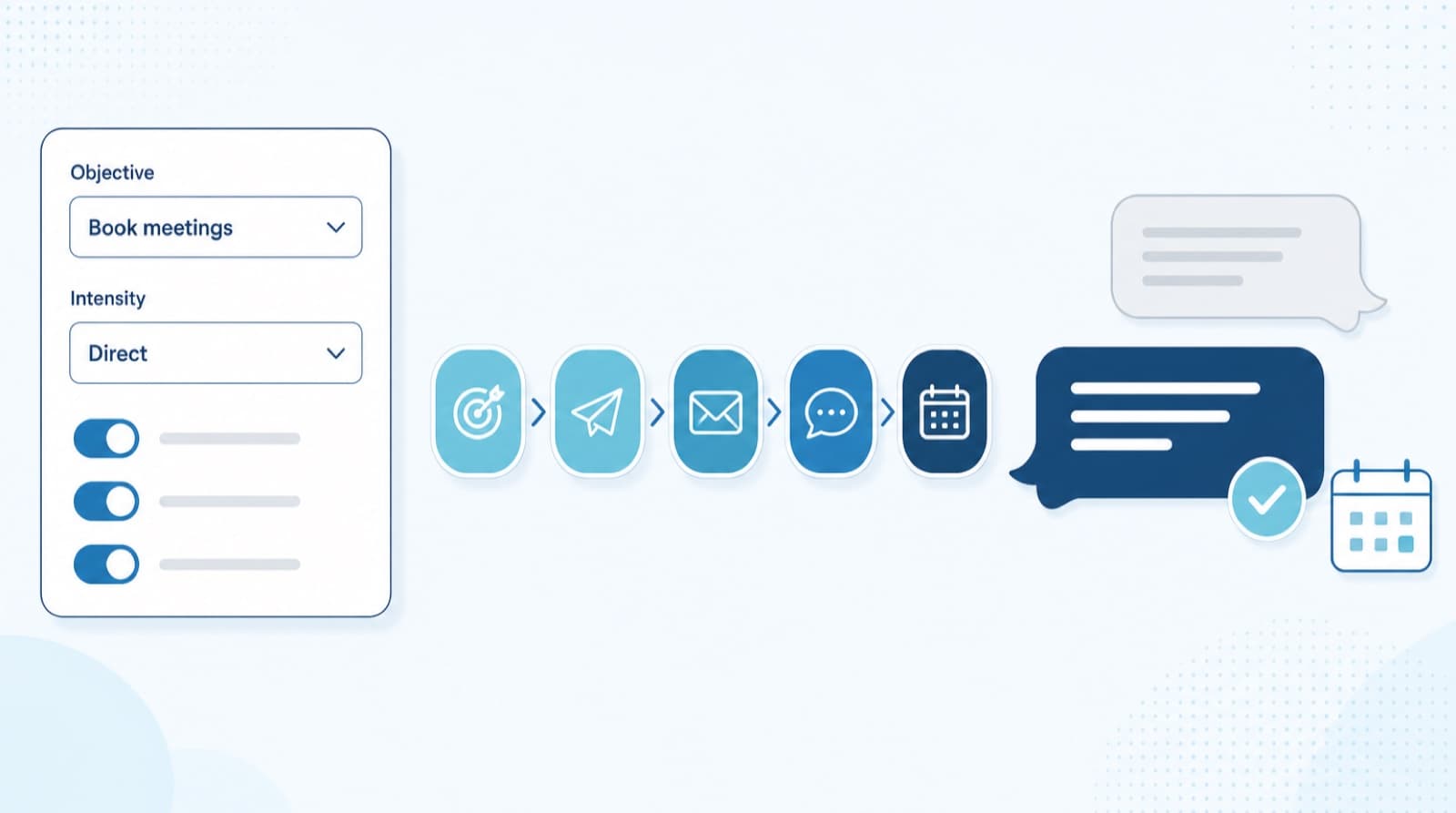
These are two independent axes, and keeping them separate is what makes the system simple. The objective is what the agent pursues. The intensity is how proactively it pursues it.
| Objective | What the agent does | Use it when |
|---|---|---|
| Book meetings | Answers well, but steers toward the calendar whenever interest is genuine | Consulting, coaching, clinics, services sold in a call |
| Answer and resolve | Solves the question and never pushes for a meeting unless asked | Support, documentation, post-sale, high-volume FAQ |
| Capture contacts | Delivers value first, then asks for contact details naturally | Long sales cycles where a human follows up later |
| Sell from catalog | Searches your catalog and guides toward the right item or reservation | Retail, real estate, rentals, anything with a product list |
| Intensity | How the agent behaves | Typical fit |
|---|---|---|
| Soft | Guides without pushing | Health, therapy, legal — anything where trust precedes commerce |
| Balanced | Proposes when there is a clear signal | Most businesses; the safe default |
| Direct | Proposes decisively as soon as there is interest | Coaching, agencies, competitive lead generation |
The two axes multiply. The same objective at a different intensity produces a genuinely different conversation. And intensity does more than adjust wording: it gates which behaviors are even available. A soft funnel never gets access to the more assertive tactics, so you cannot accidentally build an agent that pressures people.
Tactics are observable behaviors, not prompt tricks
Inside each stage, the agent's behavior is a list of toggles. Every one of them is written as something a visitor would observe, never as the technique behind it:
- Welcome — opens with a question that is easy to answer; keeps messages short and readable; never ends a message without a question.
- Discovery — asks about the situation before offering a solution; does not advance when the visitor replies tersely; remembers the visitor's underlying goal; proposes the meeting once there is real interest, not on the first message.
- Scheduling — asks permission before proposing the meeting; connects the meeting to what the person wants to achieve, not to your services; stays with the visitor while they book.
- Closing — never disqualifies anyone over budget signals; closes leaving the door open without pressure; mentions genuinely limited availability when the visitor hesitates.
The phrasing matters more than it looks. "Never ends a message without a question" is a decision any business owner can make in two seconds. "Append a trailing interrogative to the system prompt" is not a decision anyone should have to make at all.
The five stages are fixed, on purpose
Welcome, discovery, scheduling, support, closing. You can rename a stage, switch one off, and change what happens inside it — but you cannot reorder or invent stages. That is a deliberate constraint: the stages are wired to real capabilities. Scheduling is where the calendar tools live; support is where escalation to a human lives. A free-form stage editor would let you build a funnel that looks perfectly reasonable and simply cannot work. The rail stays fixed so the behavior inside it can be safely flexible. It is the same principle behind giving the agent real actions instead of scripted replies.
Support has no tactics, and that is the point
Four of the five stages carry sales behaviors. Support carries none. Support is where complaints, failures and escalations land, and commercial behavior there is not merely ineffective — it is damaging. If someone's booking just failed, "would you like to see the available times?" is exactly the wrong sentence. The funnel switches selling off, automatically, in the one place where selling destroys trust. Being genuinely present for the customer and being commercial are not the same job.
New in Okidoki: the Conversation Funnel editor
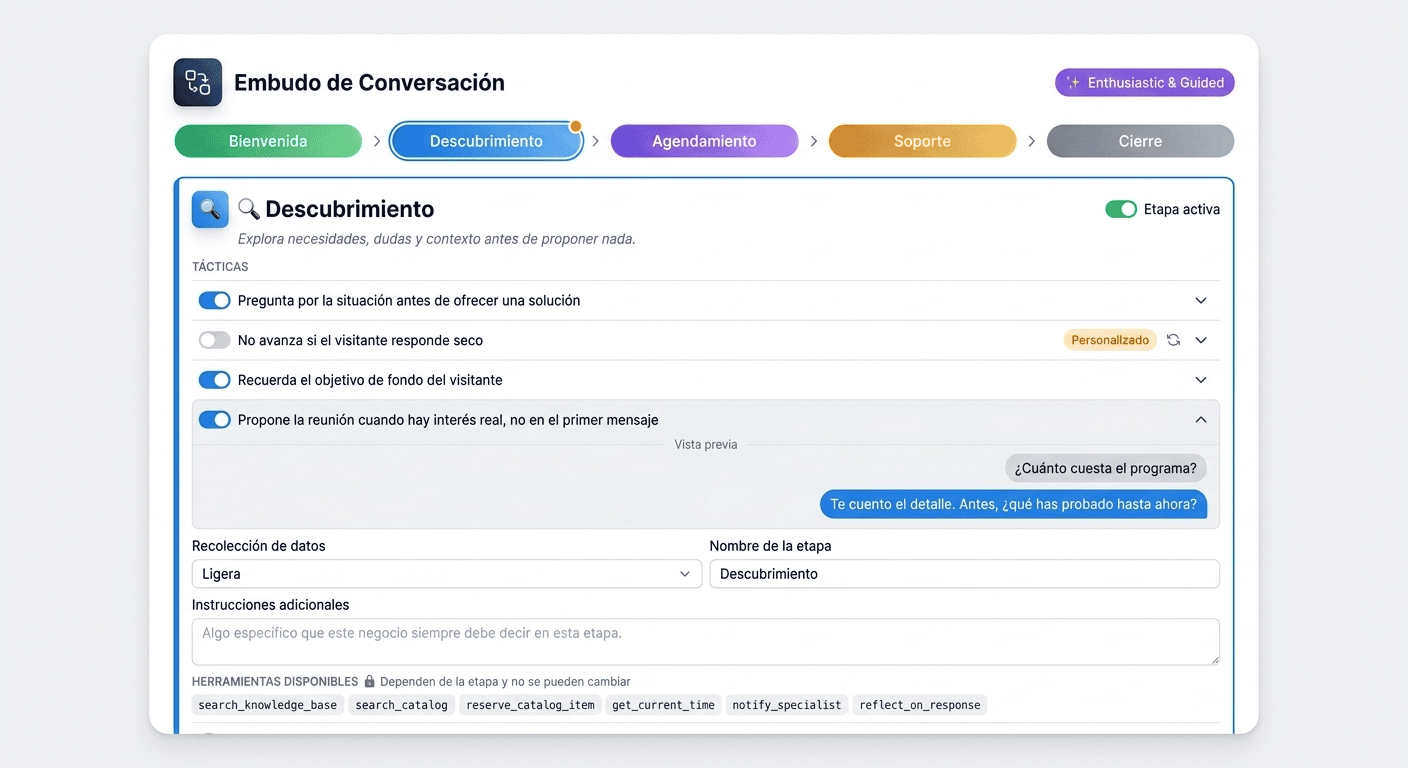
The editor is built around three levels of effort, and most businesses never leave the first two:
- Level 0 — do nothing. The funnel is seeded from your industry the moment your app exists. It already behaves sensibly.
- Level 1 — two dropdowns. Pick your objective and your intensity. This is the whole configuration for the vast majority of businesses, and it takes under a minute.
- Level 2 — open a stage. Toggle individual behaviors, rename the stage, choose how much data to collect there, and add the one instruction your business always needs to say at that moment.
At no level do you write a prompt. You make business decisions; the prompt is assembled underneath. Every toggle also shows a two-line preview of what that behavior sounds like in a real conversation, so you are choosing between outcomes rather than guessing at wording.
Tone and objective are different things
A common mistake is collapsing "how the agent speaks" and "what the agent pursues" into one setting. Okidoki keeps them apart. Your industry seeds the tone — a veterinary clinic and a law firm sound nothing alike even when both are booking meetings. Your objective is chosen independently, because a law firm might want meetings while the clinic next door wants catalog reservations. Two axes, many more useful combinations than a fixed list of personas could ever offer. If your business sells products rather than time, the same logic applies to selling from a catalog instead of just describing it.
What this covers today
To be precise about scope: the playbook governs text conversations — the website widget, WhatsApp, and email. Voice and video calls follow their own conversational setup and are configured separately. Everything described here is live in your app's settings today, and changes take effect on the next message; there is nothing to redeploy.
Open your app's settings in Okidoki, find the Conversation Funnel card, and set your objective and intensity. If the agent has been answering beautifully and booking nothing, that is usually the only change it needs.
Frequently asked questions
Do I need prompt engineering to make my AI agent sell?+
No. In Okidoki you pick a commercial objective and an intensity from two dropdowns, and optionally toggle individual behaviors per stage. The system prompt is assembled underneath from those choices, so you make business decisions rather than writing instructions for a model.
What is the difference between objective and intensity?+
The objective is what the agent pursues — booking meetings, resolving questions, capturing contacts, or selling from your catalog. The intensity is how proactively it pursues it: soft, balanced, or direct. They are independent axes, so the same objective at a different intensity produces a noticeably different conversation.
Will the "direct" intensity make my agent sound pushy?+
Direct means the agent proposes the meeting decisively once there is genuine interest — not that it pressures people. Even at direct intensity the agent still waits for real signals before proposing, never disqualifies anyone over budget, and only mentions limited availability when it is true. If your business is trust-first, soft or balanced is the better fit.
Can I use the conversation funnel for support only, without any selling?+
Yes. Choose the "answer and resolve" objective and the agent solves the visitor's question without pushing for a meeting unless they ask for one. The support stage also carries no sales behaviors at all by design, in any configuration.
Can I turn off a single behavior in just one stage?+
Yes. Opening a stage shows its behaviors as individual toggles, each with a preview of how it sounds in a real conversation. You can switch one off without affecting the other stages, and you can also rename the stage, set how much data it collects, and add a custom instruction that applies only there.
At which point in the conversation does the agent propose a meeting?+
That is exactly what the funnel controls. With the "book meetings" objective at direct intensity, the agent waits until the visitor has answered at least two questions and shown real interest before proposing — it will not propose in the first reply. At softer settings it waits for the visitor to signal readiness.
Does the conversation funnel apply to WhatsApp and voice calls?+
The playbook applies to text conversations: the website chat widget, WhatsApp, and email. Voice and video calls have their own conversational configuration and are set up separately.