Conversational AI Cost Statistics You Need to Know in 2026
Chatbot vs voice unit economics, adoption share, ROI, and market size — a short, sourced field guide for CX leaders, drawn from Gartner, MarketsandMarkets, and other public research.
Pablo Schaffner
July 19, 2026·4 min read
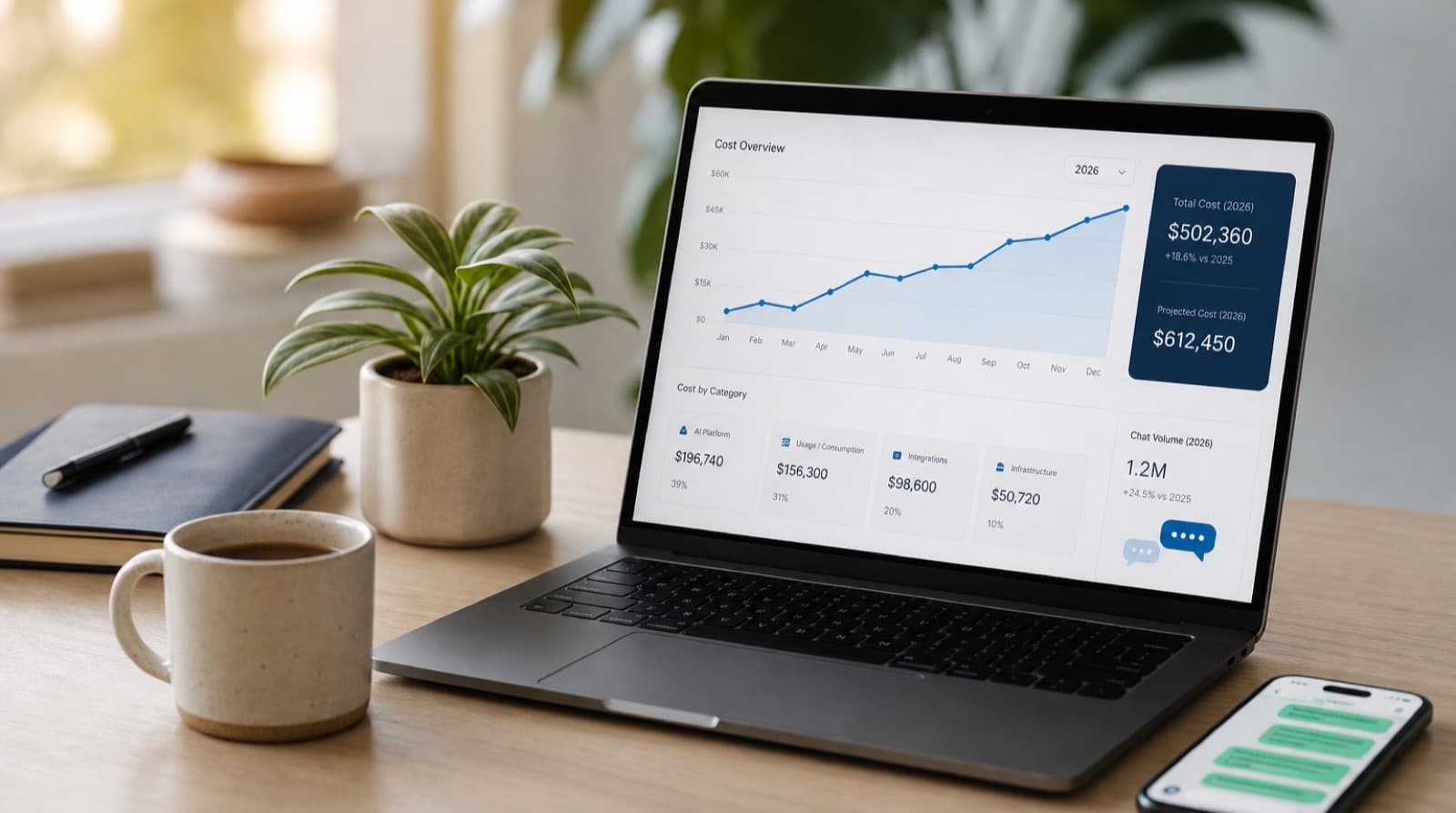
Conversational AI can slash contact-center costs — or quietly balloon your bill when voice minutes, token pools, retries, and half-automated "AI-assisted" workflows stack on top of the humans you're still paying. This is a short, sourced field guide to the numbers CX leaders and journalists cite most in 2026.
One caveat up front: market-size estimates disagree a lot because analysts measure different things (chatbots only vs. the whole contact-center AI stack). We show the range instead of pretending there's one true number.
The cost picture at a glance
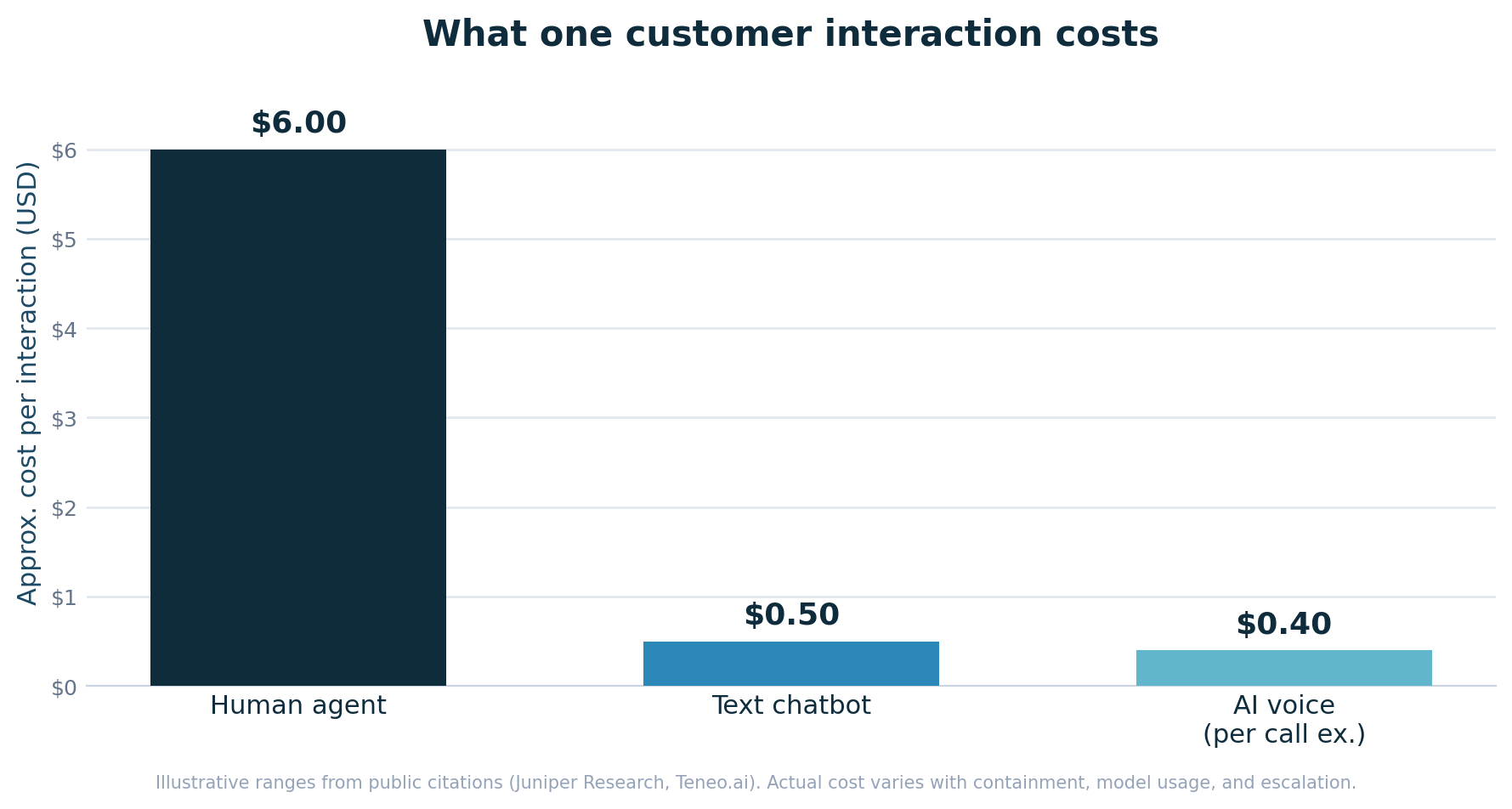
A single chatbot interaction is commonly cited around $0.50 versus roughly $6.00 for a human agent — about a 12× gap. (Source: Juniper Research, via industry synthesis, 2026)
| Channel / mode | Cited cost | Unit | Source family |
|---|---|---|---|
| Human agent | ~$6.00 | per interaction | Juniper (via synthesis) |
| Text / chat AI | ~$0.50 | per interaction | Juniper (via synthesis) |
| Human voice call (Europe) | €4–€8 | per conversation | Deloitte CX Europe 2025 (via summary) |
| AI voice | €0.15–€0.40 | per minute | Deloitte CX Europe 2025 (via summary) |
| AI voice (alt. example) | ~$0.40 vs $7–$12 human | per call | Teneo.ai (via synthesis) |
| Voice AI platforms | $0.08–$0.42 | per minute | Industry pricing synthesis |
How much is AI really handling?
Gartner estimated only ~3% of contact-center interactions were handled via contact-center AI in 2023, growing to 14% by 2027. (Source: Gartner, 2023)
The gap between "AI-touched" and "fully automated" is where savings models break. Most interactions are still augmented — meaning you pay for AI features and human labor at the same time during the transition years.
- Secondary summaries of Gartner cite that by 2027, 25% of customer-service interactions will begin in a GenAI-capable agent, up from below 5%. (Gartner, via secondary summary, 2024)
- Gartner is also cited projecting 80% of customer-service organizations will use generative AI in some form by end of 2026. (Gartner, via secondary summary, 2024)
- A Nextiva survey summarized in industry roundups reports 80% of businesses planning to add AI voice to customer service by 2026. (Nextiva, via synthesis, 2025)
Why voice bills surprise CX leaders (and how to fix it)
Under usage-based pricing of roughly $0.08–$0.42 per minute, a contact center that doubles average talk time can nearly double its AI voice spend — without adding a single new conversation. (Source: industry pricing synthesis, 2026)
The volatility isn't a law of physics — it's a pricing-model choice. It shows up when voice is billed per minute and meters stack on top of each other:
- Metered voice stacks multiple charges. ASR + LLM + TTS + telephony can all bill at once, so per-minute agentic voice is harder to forecast than a FAQ chatbot.
- Retries and tool calls multiply tokens beyond the "happy path" demo cost — especially in longer, agentic dialogues.
- Low containment erases the savings case. With only ~3% fully automated in 2023 (Gartner), poorly capped, per-minute voice can cost more than the humans it was meant to replace.
The antidote is deterministic pricing. When a vendor bundles a fixed pool of voice minutes into a flat monthly plan and caps individual calls, voice becomes as predictable as text — you know the ceiling before the month starts. That's the model we chose at Okidoki: each plan includes a set minute allowance and calls are capped by default, so your bill doesn't move with call volume. Whether you build or buy, insist on included-minute bundles and per-call caps instead of open-ended per-minute metering.
ROI — and what actually moves it
Gartner is widely cited projecting conversational AI will save about $80 billion in contact-center labor costs by 2026. (Source: Gartner, via Precedence Research, 2026)
- Forrester TEI-style studies summarized in roundups cite 3-year voice AI ROI of 331%–391% for specific vendor deployments. (Forrester / PolyAI TEI, via synthesis, 2025)
- Secondary summaries of Gartner cite ~30% average customer-service cost savings for full conversational-AI deployments. (Gartner, via secondary summary, 2025)
- Intercom has publicly discussed average AI-agent resolution rates around 76% (containment without human escalation). (Intercom, via synthesis, 2026)
The metric that survives scrutiny is cost per resolution, not tokens, minutes, or messages — because it folds in retries, escalations, and failed automations, which is exactly where demos are misleading.
How big is the market? (pick your scope)
Worldwide contact-center + conversational-AI/virtual-assistant spending was projected at $18.6B in 2023, up 16.2% year over year, rising to $23.2B in 2024. (Source: Gartner, 2023)
| Source | Near-term size | Longer-term | CAGR |
|---|---|---|---|
| Gartner (CC + conversational AI spend) | $18.6B (2023) | $23.2B (2024) | 16–24% near-term |
| MarketsandMarkets (conversational AI) | $17.05B (2025) | $49.8B (2031) | 19.6% |
| Grand View Research (conversational AI) | $17.7B (2026) | $78.9B (2033) | 23.8% |
| Precedence Research (conversational AI) | $19.21B (2025) | $155.23B (2035) | 23.24% |
The durable takeaway isn't any single figure — it's the direction: strong double-digit growth, with voice and agents rising faster than simple FAQ bots (one voice-AI-agents series projects a 34.8% CAGR to 2034). (Market.us, via synthesis, 2024)
What to ask vendors before you scale
Bring this checklist to any CCaaS or AI vendor conversation:
- A rate card per channel (chat vs. voice vs. WhatsApp), not a single blended price.
- Clear billable-event definitions — is it a message, a session, or a resolution?
- Usage caps and burst-pricing transparency so a traffic spike can't blow up the invoice.
- Cost-per-resolved-conversation reporting, not just tokens or minutes.
- Documented fallback behavior when the AI can't resolve — and who pays for the human hop.
Compiled by Pablo Schaffner, founder of Okidoki Chat — an AI chat widget that qualifies website visitors and books meetings via text, voice, video, or WhatsApp. Sources referenced in plain text: Gartner, MarketsandMarkets, Grand View Research, Precedence Research, Deloitte CX Europe (via summaries), and industry syntheses of Juniper Research, Teneo.ai, Forrester TEI, Intercom, and Nextiva.
Frequently asked questions
How much does a chatbot interaction cost vs a human agent?+
Public industry citations commonly put chatbot interactions around $0.50 versus about $6.00 for human agents — roughly a 12× difference — though your actual unit cost depends on containment, model usage, and escalation rate.
Why is usage-based voice AI harder to forecast than chatbots?+
When voice is billed per minute it can stack ASR, LLM, TTS, and telephony charges at once, so longer calls, retries, and agentic tool calls multiply spend even when conversation count stays flat. That volatility comes from the metered pricing model, not from voice itself.
Does voice AI have to be unpredictable?+
No. Per-minute metering is what makes voice volatile — not the technology. Vendors that bundle a fixed pool of voice minutes into a flat monthly plan and cap individual calls make voice cost deterministic, so you know the ceiling before the month starts. Okidoki works this way: each plan includes a set minute allowance and calls are capped by default.
What share of contact-center interactions are fully handled by AI today?+
Gartner estimated about 3% of interactions handled via contact-center AI in 2023, rising toward 14% by 2027 — meaning most volume still involves humans during the transition.
How large is the conversational AI market in 2025–2026?+
Estimates vary by scope. MarketsandMarkets cites $17.05B in 2025 growing to $49.80B by 2031; other firms publish higher or lower figures depending on what they include.
What should CX leaders ask vendors before deploying AI at scale?+
Ask for channel rate cards, billable-event definitions, usage caps, cost-per-resolution reporting, and contractual protections for burst pricing — not only feature demos.
Will conversational AI reduce contact-center labor costs?+
Gartner is widely cited projecting about $80B in labor-expense savings from conversational AI in contact centers by 2026, alongside average savings claims around 30% for full deployments in secondary summaries.